Requirements
Requirements Analysis
The project requirements are divided into two main categories: functional and non-functional. This classification distinguishes between the specific capabilities the accelerator must provide and the quality attributes, adaptability, and constraints of its implementation.
Functional Requirements
Software Configuration
The accelerator is configured via software using the Register Interface. The input parameters include: the number of bands in the HSPs, the number of reference signatures in the spectral library, and the memory addresses of the captured HSP and the spectral library.
The accelerator’s status can be queried through a status register composed of several bits — some writable and others read-only. The writable bits allow starting and stopping the accelerator, while the read-only bits report its current status (idle, ready) and indicate how the last operation ended (done, error, cancelled).
Additionally, four registers identify the reference signature that most closely matches the captured HSP and the one that differs the most. For each, both the identifier and the calculated MSE value are provided.
Spectral Library Memory Structure
The spectral library must be stored in memory following certain constraints to ensure compatibility with the accelerator. Multiple libraries can coexist in memory, each with its own starting address. Reference HSPs must contain the same number of bands as the captured HSPs, and their bands must appear in the same order and correspond to the same wavelengths. All reference signatures within the same library must be stored in consecutive memory locations.
The accelerator targets X-HEEP systems with 32-bit RISC-V processors. In this case, each memory word packs two consecutive bands of an HSP. If the number of bands is odd, the least significant part of the last word is padded with zeros.
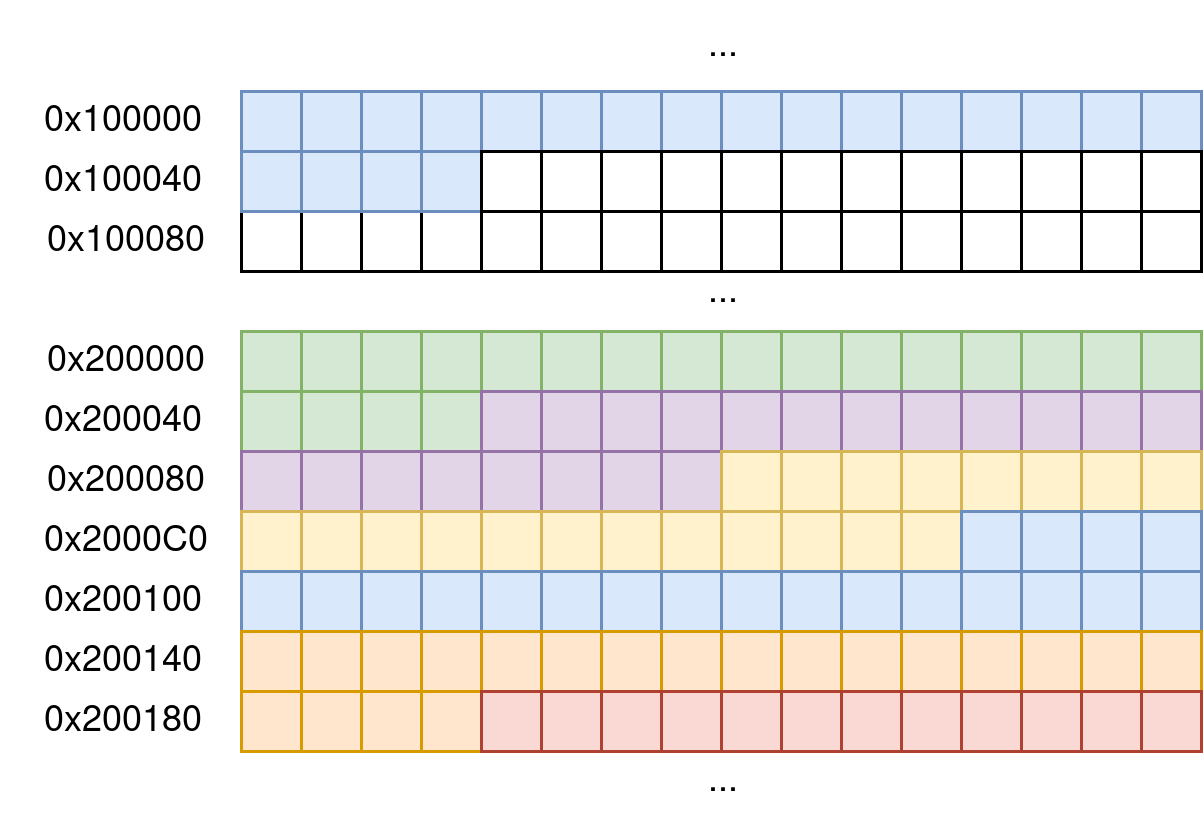
In systems with 64-bit processors, four bands could be packed per word. However, supporting this would require RTL code modifications, which are outside the scope of this project.
Transfer of HSPs to the Accelerator
HSPs can be transferred to the accelerator using either a passive (slave) or active (master) approach. In passive mode, the accelerator waits to receive data via the OBI bus — either from a DMA or via processor-controlled transfers. In active mode, the accelerator knows the memory addresses of the captured HSP and the spectral library, and directly fetches data via a master controller.
In the HSpecID-X design, active mode is preferred to reduce reliance on external software or DMA controllers.
Clear Function in All Modules
All modules must implement a clear function that resets internal registers to their default values, cancels ongoing pipeline operations, and restores state machines to their initial states. This function has the highest priority within each module.
Integer Arithmetic Operations
This version of the accelerator uses integer arithmetic units for addition, subtraction, multiplication, and division, implemented using SystemVerilog's built-in operators.
Addition, subtraction, and multiplication can be synthesized using DSP blocks, enabling single-cycle execution. In contrast, division requires multiple cycles and a dedicated implementation module. However, this lies outside the scope of the current project.
Clock and Reset Signals
All RTL modules are synchronized to the rising edge of a single clock domain used throughout the accelerator. A clock period of 10 ns (i.e., 100 MHz) is assumed. However, since the project was not synthesized, this operating frequency is only indicative.
The reset signal is active-low and handled asynchronously. While asynchronous resets have some drawbacks, they offer simplicity in combinational logic and independence from the clock signal, which were prioritized in this project You can read more about this topic on the paper Synchronous Resets? Asynchronous Resets? I am so confused! How will I ever know which to use?.
Communication Between Modules
Module communication occurs primarily via two mechanisms: the Valid-Ready protocol and a block control interface based on a Handshake mechanism.
In the Valid-Ready protocol, input data is accompanied by a control signal (ready or enabled) indicating that the data should be interpreted. Output data is accompanied by a valid signal to confirm availability.
In modules controlled by FSMs, internal states are communicated through a block
control interface that includes at least the signals: idle, ready, done,
and start.
Non-Functional Requirements
RTL Parameterization of Word Widths
The HSpecID-X accelerator supports RTL-level parameterization of word widths
using the SystemVerilog parameter keyword. This allows adaptation to different
integration scenarios, especially within the X-HEEP ecosystem.
| Parameter | Description | Default | Modifiable |
|---|---|---|---|
WORD_WIDTH |
X-HEEP word width | 32 bits | No |
DATA_WIDTH |
Width of each HSP band | 16 bits | No |
DATA_WIDTH_MUL |
Width of multiplication result | 32 bits | Yes |
DATA_WIDTH_ACC |
Width of accumulator | 40 bits | Yes |
HSP_BANDS_WIDTH |
Bit-width for the number of bands per HSP | 7 bits | Yes |
HSP_LIBRARY_WIDTH |
Bit-width for the number of reference signatures | 6 bits | Yes |
FIFO_ADDR_WIDTH |
FIFO address width | 2 bits | Yes |
These parameters are declared in the hsid_pkg SystemVerilog package, ensuring
global consistency throughout the project. By convention, general-purpose
parameters are prefixed with HSID_.
You can learn more about how to parametrize this accelerator in the hardware configuration section.
Expected Performance
The primary performance bottleneck is expected to be data transfer from memory to the accelerator. Assuming a 32-bit word width and a 100 MHz clock, the theoretical maximum transfer rate is 3.2 Gb/s.
If each HSP has n bands and the spectral library contains m reference signatures, the estimated processing time per HSP is:
Here, each cycle transfers two bands from memory. The constant c depends on pipeline latency and accelerator initialization overhead.
You can learn more about the final performance of this accelerator.
Module Reusability
Although designed for integration with X-HEEP, the accelerator must also be reusable in other ad hoc environments—either as a standalone IP core or through adapters to other bus protocols such as AMBA (AXI, AHB, APB) or open-source buses like Wishbone.
To distinguish the core logic from the X-HEEP integration logic, a consistent
naming convention is used: Modules implementing the core accelerator
functionality use the prefix hsid_, while modules for X-HEEP integration use
the prefix hsid_x_.