Introduction
Introduction
Electromagnetic Spectrum and Spectral Libraries
The electromagnetic spectrum comprises all frequencies at which electromagnetic radiation can propagate as a wave. Using a spectrometer, it is possible to measure the light intensity of an emitting or reflecting object at each wavelength. Once this information is obtained—and the observed material is known—it is possible to generate a characteristic spectrogram for each type of material.
Libraries exist that collect spectrograms of numerous materials for use as reference sources. These libraries have been created using different observation techniques across various wavelength ranges. For example, the ECOSTRESS Spectral Library includes more than 3,000 spectrograms of both natural and artificial materials. The wavelength ranges covered by this library are VIS/SWIR (0.35–2.5 μm) and TIR (2.5–15 μm).
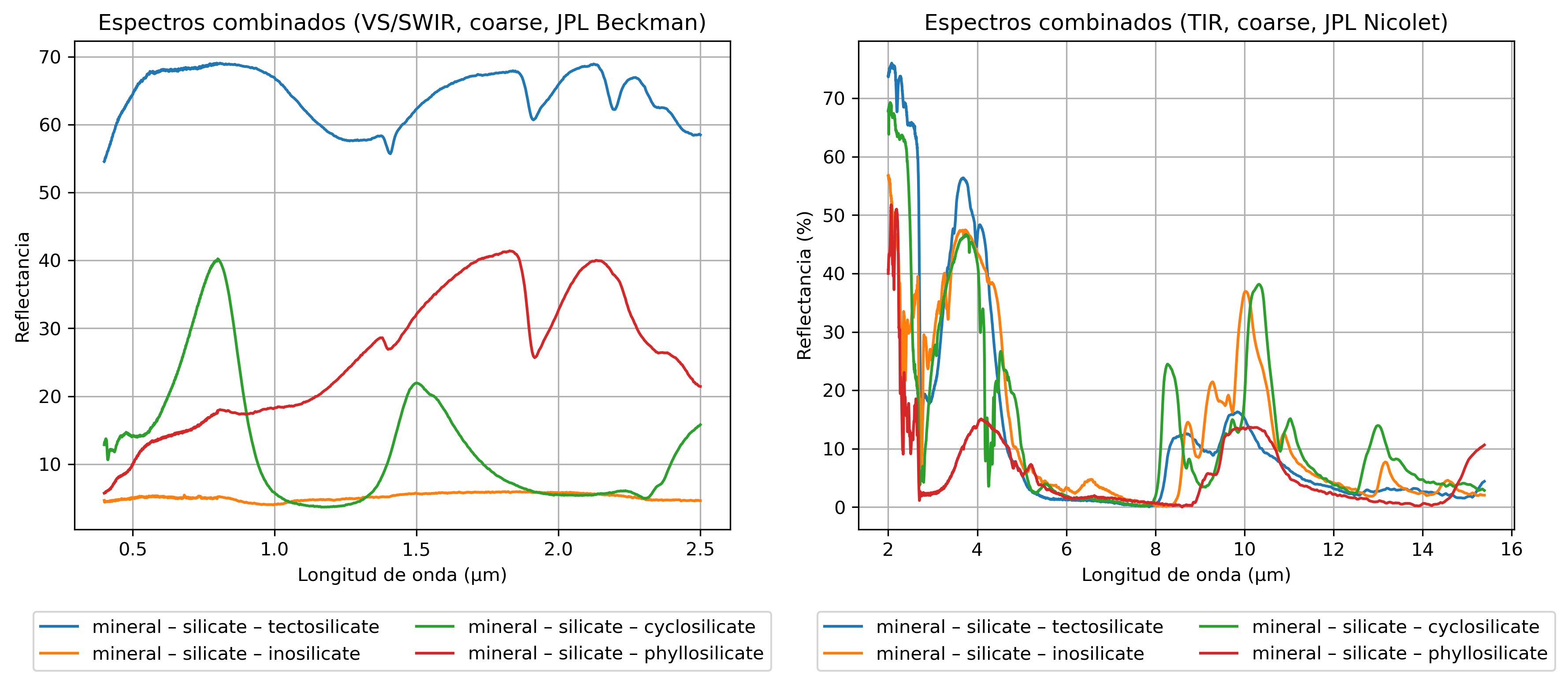
These spectrograms differ significantly, even among materials from the same category. Ultimately, they can be considered as reference signatures or "fingerprints" of the materials. Therefore, if the spectrogram of an observed object is acquired, its composition and nature can be determined.
Hyperspectral Cameras and Images
These spectrograms are acquired using spectrometers or hyperspectral cameras. The main difference is that a hyperspectral camera can capture two-dimensional images that combine spatial and spectral information for each pixel. This enables the identification of material composition at specific positions within the image.
A hyperspectral image (HSI) can be represented as a data cube: two dimensions correspond to spatial information, while each hyperspectral pixel (HSP) contains the intensity of multiple narrow spectral bands within a defined wavelength range.
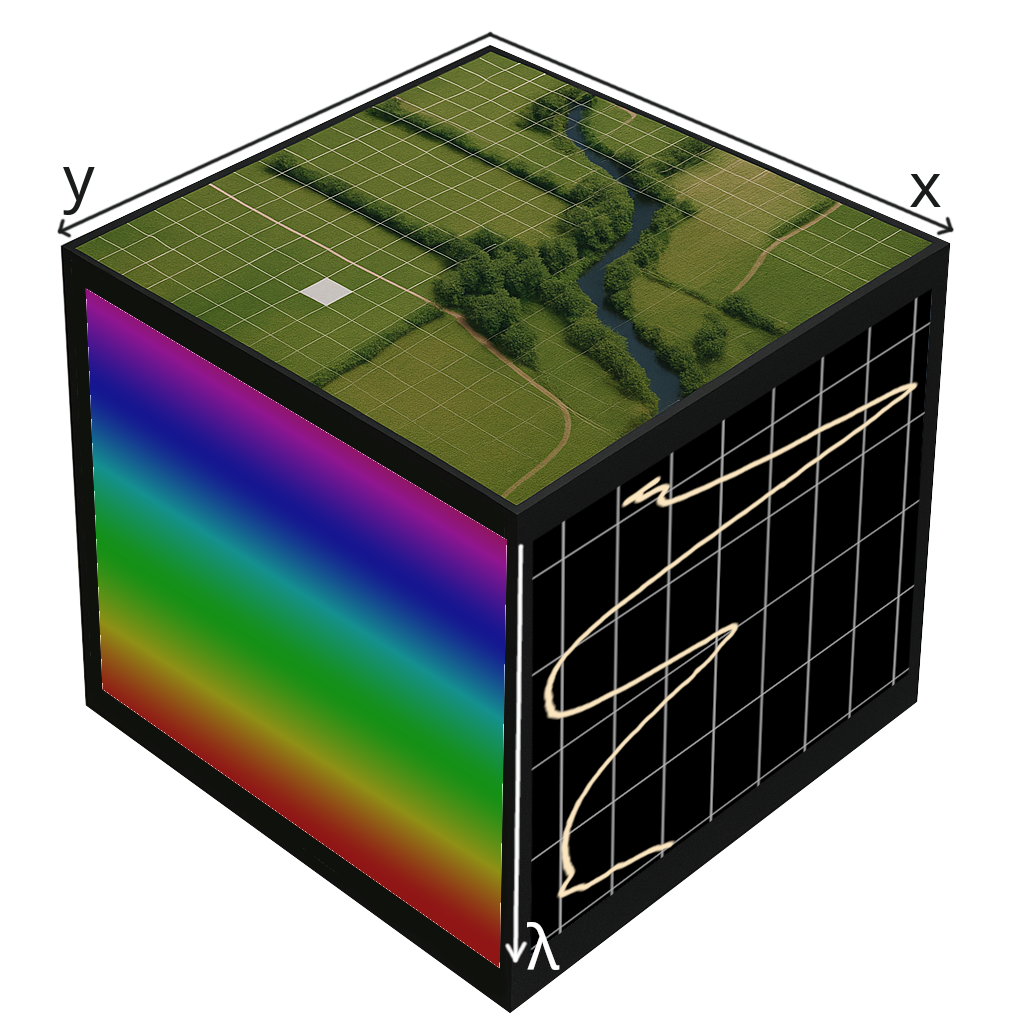
Unlike an RGB image, which collects information from only three broad spectral bands in the visible range (red, green, and blue), a hyperspectral image can contain hundreds of narrow bands across the visible, infrared, or other regions of the spectrum.
Hyperspectral cameras acquire HSIs using two techniques: snapshot, in which all pixel information is captured simultaneously, and scanning, in which data is acquired pixel by pixel. The latter technique provides higher precision but results in slower acquisition speeds.
Hyperspectral Image Processing
Once HSIs are acquired, they must be processed to extract relevant information. A single HSI can contain hundreds of megabytes of data, making processing computationally demanding.
The application domains for HSIs are highly diverse: agricultural monitoring, detection of toxic substance leaks, security, and even medicine and biological analysis in laboratories. HSIs are also used for large-scale terrain exploration, as well as in the study of inaccessible environments such as asteroids and other planets.
Some classification and change detection algorithms rely on convolutional neural networks (CNNs), which require powerful GPU-based workstations to process the large volume of HSI data.
However, many hyperspectral cameras are installed on satellites or UAVs, where onboard processing must occur under tight resource constraints. These embedded systems often rely on low-power processors without GPUs. Therefore, tasks such as preprocessing, lossless compression, or basic classification can be offloaded to hardware accelerators implemented in FPGAs or ASICs.
A simple classification approach is to use the Mean Squared Error (MSE) to quantify the difference between two vector measurements, one of which serves as a spectral reference.
Mean Squared Error (MSE)
HSPs can be considered as vectors, where each index corresponds to a narrow spectral band and the associated value represents the normalized light intensity at that band. To compare two HSPs, they must contain measurements for the same bands and have equal length.
If two HSPs are of equal length, their difference can be measured by computing the squared error: subtracting each pair of corresponding values and squaring the result. This emphasizes large discrepancies while reducing the influence of smaller ones.
The MSE is a statistical measure that calculates the average of the squared errors between two vectors. Given a reference signature \(r = (r₁, r₂, …, rₙ)\) and a captured HSP \(x = (x₁, x₂, …, xₙ)\), the MSE is defined as:
To identify a captured HSP among reference signatures in a library, the MSE should be minimized. A value of 0 indicates that the spectrograms are identical, which implies a perfect match and enables precise material identification.
Other metrics used to evaluate similarity include the Mean Absolute Difference (MAD) and the Spectral Angle Mapper (SAM).
Although conceptually simple, these algorithms are computationally intensive, involving numerous subtraction and multiplication operations. As such, executing them on general-purpose processors—where operations are performed sequentially—is inefficient. An effective alternative is the use of Domain-Specific Accelerators (DSAs), which exploit the inherent parallelism of these algorithms.
Domain-Specific Accelerators (DSA)
General-purpose processors execute applications by interpreting instructions stored in memory. Their architectures are versatile and flexible, making them suitable for a wide range of tasks. However, this flexibility limits their efficiency when performing highly parallel or computationally intensive operations.
To improve efficiency in such scenarios, systems often integrate hardware accelerators. These components are specialized to perform a specific task more efficiently than a general-purpose processor. Two widely known types are GPUs, commonly used for graphics rendering and AI workloads, and DSAs, typically implemented in FPGAs or ASICs.
A DSA is a hardware module tailored to a specific computational task. It features optimized data paths and control logic designed for a narrowly defined use case. Although DSAs lack the flexibility of general-purpose processors, they achieve high performance by executing operations in parallel and using memory architectures that support the algorithm’s structure.
Technological context
RISC-V
RISC-V is an open Instruction Set Architecture (ISA) based on the Reduced Instruction Set Computing (RISC) paradigm. It originated in 2010 at the University of California, Berkeley, as an academic project aimed at supporting education and research. Today, the development and maintenance of its specifications are overseen by RISC-V International.
One of RISC-V’s most significant features is its modularity. Processor developers can select which standards and extensions to implement. For example, a processor that supports only the basic RV32I standard is much simpler to implement than one that includes multiple extensions, resulting in lower power consumption but also reduced computational capacity and flexibility.
As an open and royalty-free standard, RISC-V has emerged as a prominent alternative to proprietary ISAs such as x86 and ARM, particularly in academic research and processor development. It also serves as the foundation for platforms such as X-HEEP, which is used in this project.
X-HEEP
X-HEEP is an extensible, open-source System-on-Chip (SoC) platform that enables the creation of customized embedded systems based on RISC-V processors. Its main features include low power consumption and highly parameterized peripherals, allowing the system to be adapted to a wide range of performance and efficiency requirements. For these reasons, it is well suited for integrating accelerators, memory blocks, and application-specific peripherals.
The architecture of X-HEEP is organized into four power domains: the CPU, memory banks, peripheral systems, and always-on peripheral systems. Some peripherals can be disabled at runtime, enabling significant power savings. The system can also be extended through the inclusion of custom coprocessors or accelerators via the XIF and XAIF protocols, which were designed for this purpose.
Customization of the SoC is performed through scripts that allow users to select the processor, memory size and type, and assign peripherals to memory-mapped addresses for software access. It is also possible to embed the software to be executed on the SoC, either as a bare-metal program or an RTOS.
Once the customized SoC is configured and verified with the required peripherals, it can be synthesized onto an FPGA for rapid prototyping or fabricated as an ASIC for deployment. A notable example is HEEPocrates, an ASIC for edge computing in healthcare that integrates X-HEEP with a CGRA and an IMC accelerator.
eXtended Accelerator Interface (XAIF)
The XAIF interface enables the integration of custom accelerators into the X-HEEP platform without requiring modifications to the base RTL code. It consists of the following components:
- Master/slave ports, which are memory-addressable interfaces that communicate via the OBI bus or through the Register Interface.
- Interrupts, which allow the accelerator to notify the processor of specific events.
- Power control ports, which enable X-HEEP to manage the accelerator’s power consumption.
RTL Designs vs. High-Level Synthesis (HLS)
Modern hardware designs can be derived from high-level algorithm descriptions written in languages such as C++ or SystemC using High-Level Synthesis (HLS) tools. This development approach significantly reduces implementation time and facilitates architectural exploration. However, it may lead to lower efficiency in terms of area and latency when compared to manually written RTL designs.
In this project, a direct RTL design approach was chosen to allow fine-grained control over the architecture, dataflow, and resource utilization. Additionally, this approach enables the definition of a modular, reusable, and adaptable system for future projects or for integrating other HSP classification algorithms. In summary, design efficiency was prioritized over rapid development via HLS tools.