Squared Difference Accumulator (hsid_sq_df_acc)
The purpose of this module is to compute the difference between two bands, square it, and accumulate the result with previous values. To achieve a throughput of one result per cycle, the module is designed with a segmented data path organized into a three-stage pipeline.
The figure below shows this pipeline structure and the operations performed in each stage. In the first stage, subtraction is performed; in the second, multiplication; and in the third, intermediate accumulation.
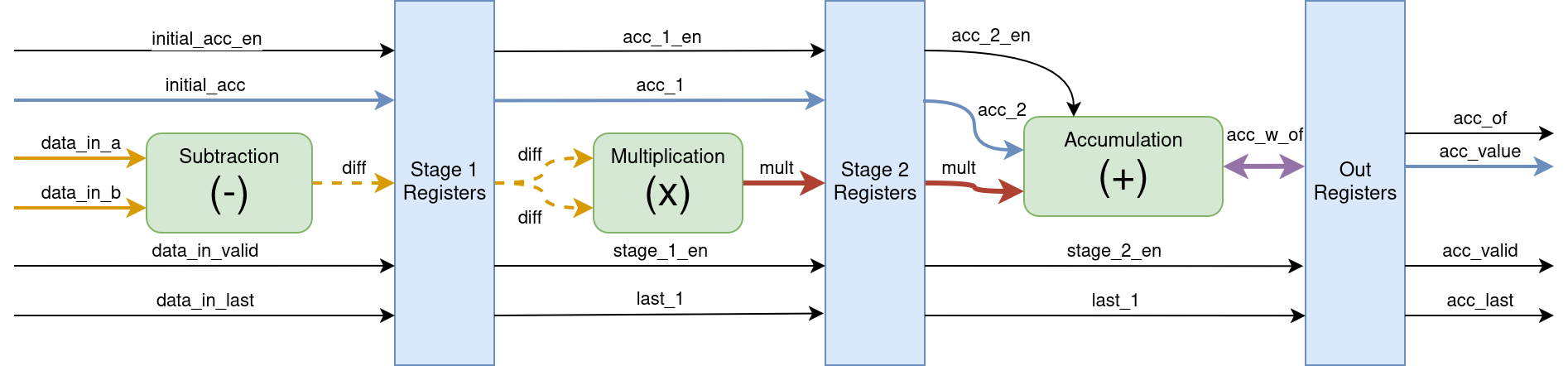
The result of the subtraction is stored in an intermediate register of the same
bit width as the input values but of type signed. To prevent overflow, the
multiplication result must be twice the input bit width.
The accumulator is initialized through the input signals initial_acc_en and
initial_acc. These signals propagate through the pipeline to the final
stage, where the control logic determines whether to accumulate over the
previous values or use the initial accumulator. An accumulation may cause an
overflow, which is indicated by the output signal acc_of. This signal is
reset when initial_acc_en is asserted.
The signal data_in_last indicates that the input corresponds to the final band
of the HSP. In this way, the final accumulated value can be identified
through the output signals acc_last and acc_valid.
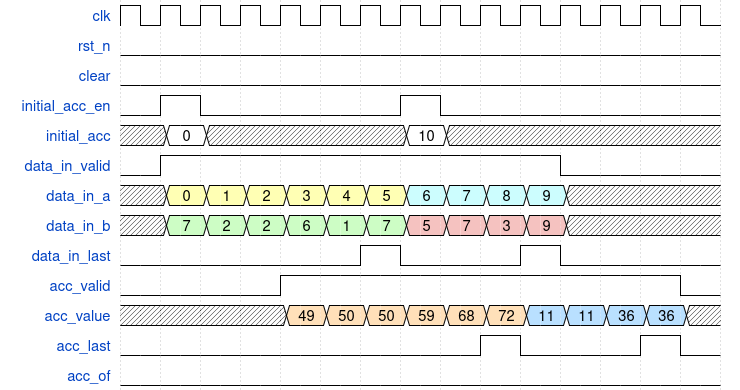
The figure below illustrates a waveform example showing the accumulation process for two sequences of numbers with different initial values. The latency of this module is 3 cycles1. Therefore, although intermediate accumulated results are produced every cycle, the effective throughput is one result per cycle.
-
We are supposing that the latency of the multiplication is the only one cycle, and that can be true if you're using DSP units. Other possiblity is to use a pipelined multiplication module. ↩