Mean Squared Error (hsid_mse)
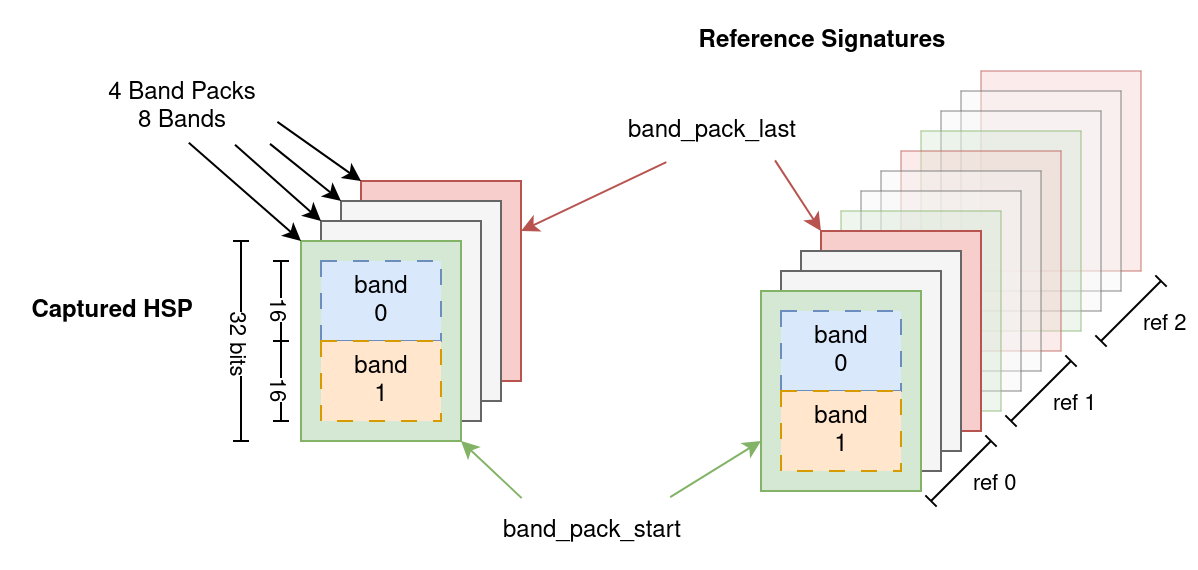
The purpose of this module is to complete the MSE computation between the
captured HSP and a reference signature from the spectral library. The data
input width is 32 bits, meaning that two consecutive bands are introduced
simultaneously for both the captured HSP and the reference signature. The figure
below shows how the beginnings and ends of each HSP are delimited. Each
reference signature is associated with an identifier (hsp_ref) corresponding
to its position in the spectral library.
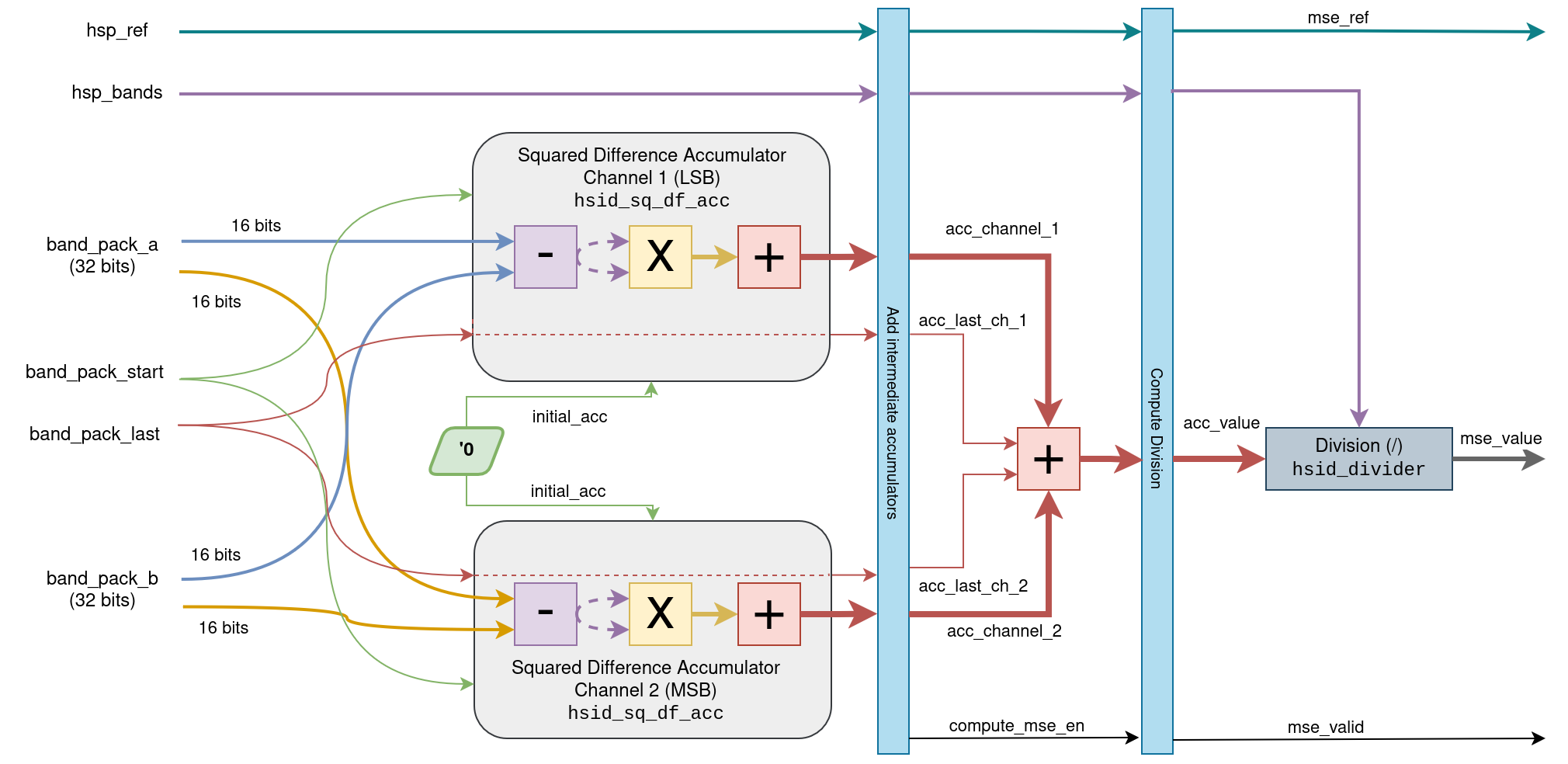
Since the data input provides two consecutive bands, processing can be performed
in parallel using two instances of the hsid_sq_df_acc
module. The intermediate accumulated results obtained from both instances are
added together and finally divided by the number of bands in the HSP. The
dataflow of the hsid_mse module is illustrated in the following figure.
For an HSP of n bands, the latency of this module is \(\frac{n}{2} + 4 + (K +
1)\) cycles: \(\frac{n}{2}\) cycles for transferring the band_packs, plus four
cycles to complete the hsid_sq_df_acc pipeline and the
final accumulator, and \(K + 1\) cycles to perform the division yielding a
K-bit result within the hsid_mse module. Both HSP and reference
signature must contain more than \(4 (K + 1)\) bands to avoid issues with
hsid_divider as this module is not pipelined.
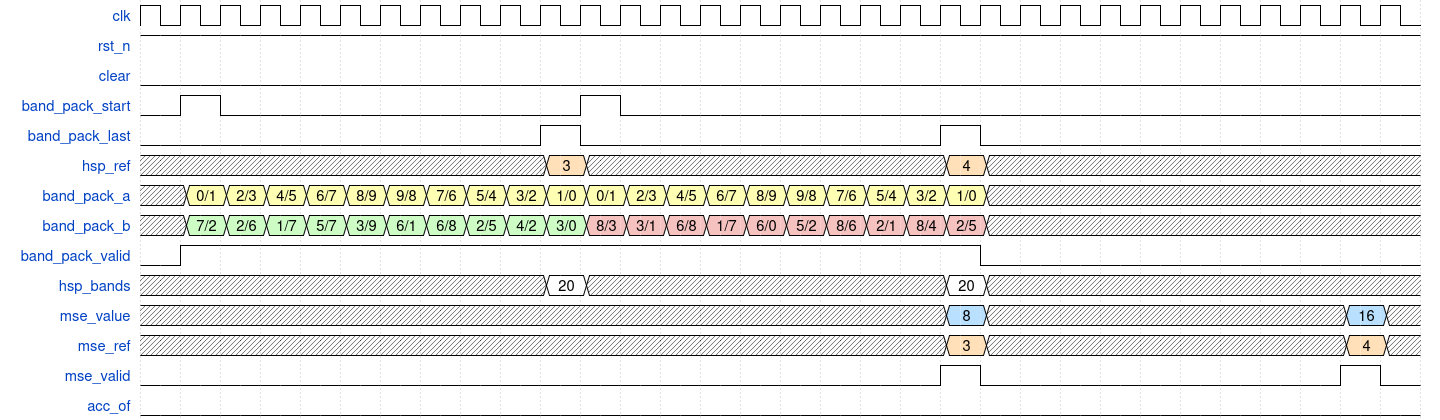
The figure below shows an example waveform illustrating the computation of the
MSE for two consecutive reference signatures using the hsid_divider module
with a divider of 5 bits.