Top Module
HSpecID-X (hsid_x_top)
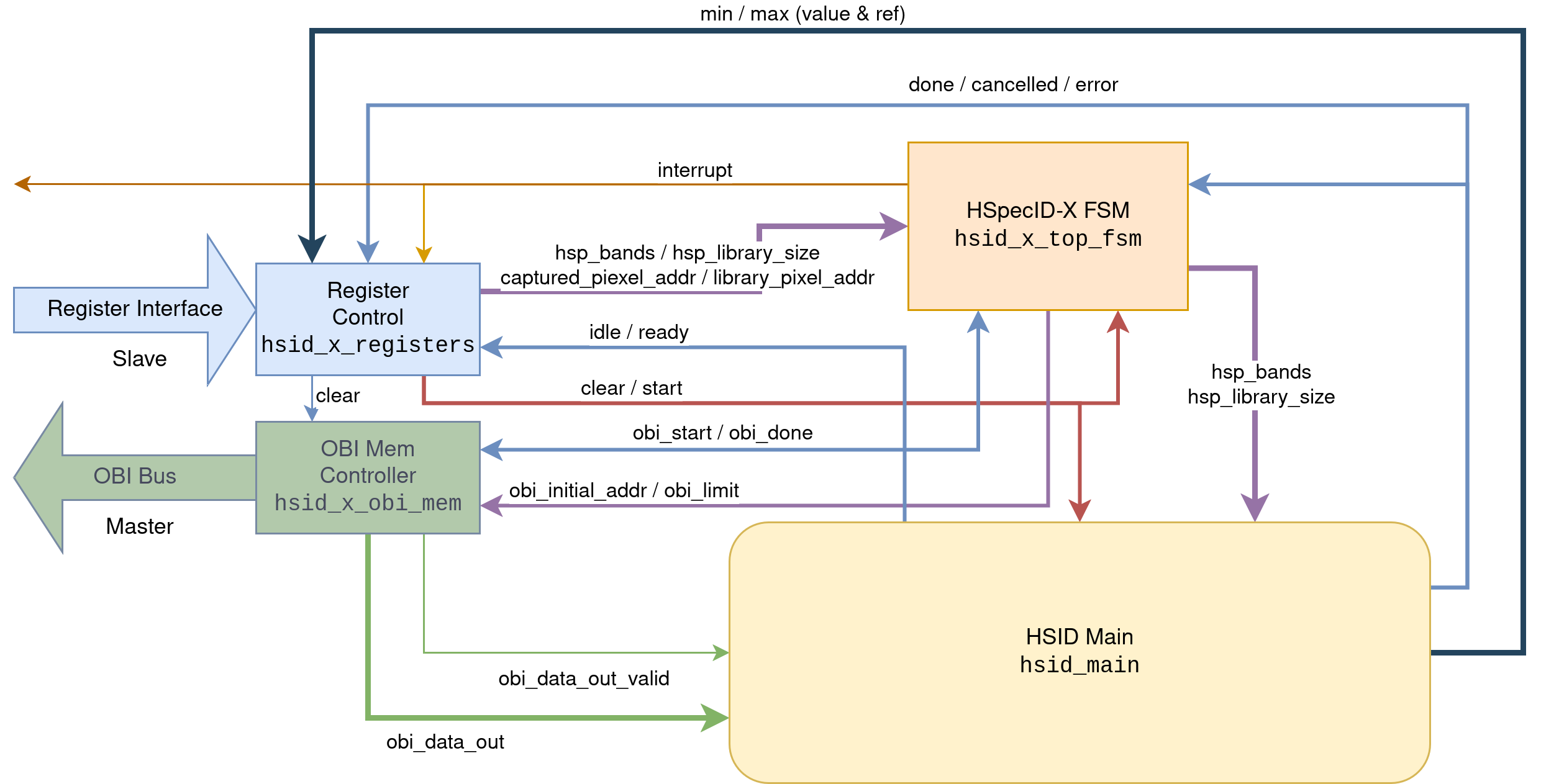
This module serves as the project’s top-level integration unit, incorporating all previously described components. The figure below shows the integration diagram, in which signals are semantically grouped to simplify the representation.
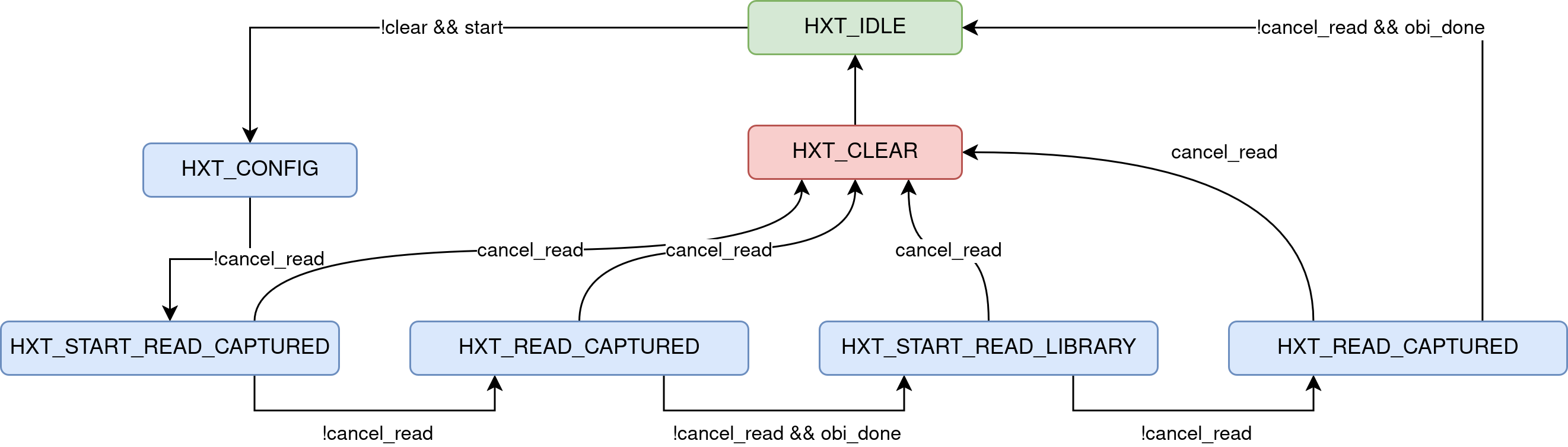
The synchronization between memory read operations and data injection into
hsid_main is managed by an FSM, shown in the figure below:
This module can be directly integrated into an X-HEEP-based SoC. Once
configured and assigned memory-mapped addresses within the SoC, it can be
controlled from a C application according to the register offsets described in
the hsid_x_ctrl_reg documentation.
First, the software must configure the execution parameters: the number of bands
per HSP (PIXEL_BANDS), the number of reference signatures in the spectral
library (LIBRARY_SIZE), and the memory addresses of the captured HSP and
the spectral library (CAPTURED_PIXEL_ADDR and LIBRARY_PIXEL_ADDR).
Once the parameters are configured, the operation begins by setting the START
bit of the STATUS register to 1. Upon completion, the accelerator issues an
interrupt to the processor. The accelerator’s state can be queried through the
STATUS register, whose main bits are:
IDLE: indicates that the accelerator is inactive.DONE: indicates that the last operation completed successfully.CANCELLED: indicates that the current operation was cancelled.ERROR: indicates that the initial configuration is invalid.
The ongoing operation can also be cancelled by setting the CLEAR bit of the
STATUS register to 1. In this case, the dataflow is stopped, and all
internal registers are reset to their default values.
Finally, the results of the last operation are accessible via software. The
MSE_MIN_REF and MSE_MIN_VALUE registers indicate the spectral signature that
most closely matches the captured HSP, while MSE_MAX_REF and
MSE_MAX_VALUE store the signature that differs the most.